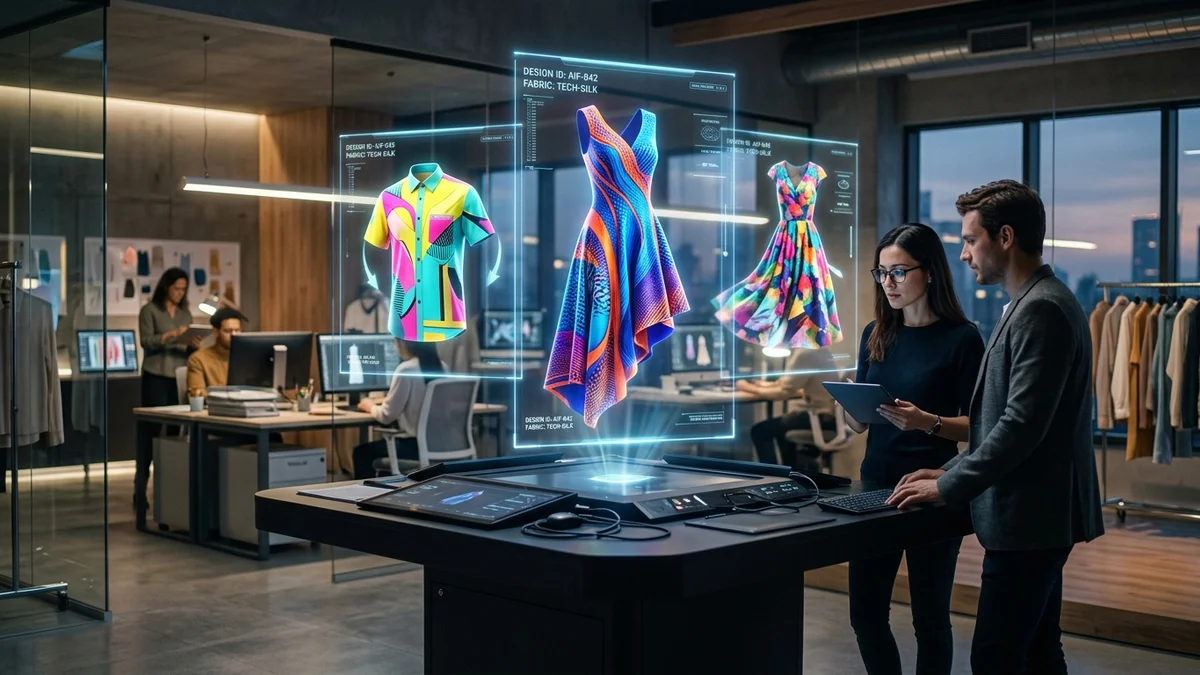
AI generated clothing lets anyone create original fashion designs in seconds using text prompts or sketches. Whether you want to visualize a new dress concept, generate shirt mockups, or build an entire collection digitally, AI clothing generators make it possible without drawing skills or expensive software.
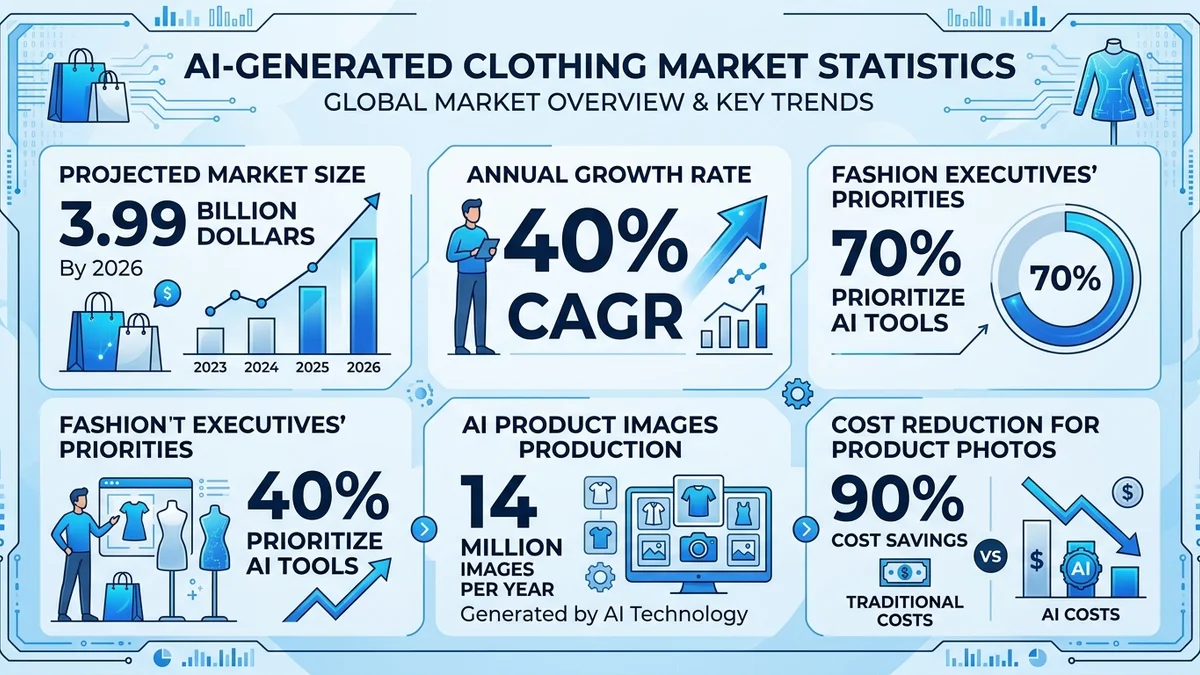
The AI fashion market hit $3.99 billion in 2026, growing at nearly 40% per year. Fashion brands, independent designers, and hobbyists are all using these tools to speed up their creative process. From generating photorealistic clothing images to producing AI fashion models wearing your designs, the technology has matured fast.
This guide covers everything you need to know about AI generated clothing in 2026. You will learn how these tools work, which ones are worth trying, and practical tips to get the best results from any AI clothing generator.
At a Glance
AI generated clothing uses artificial intelligence to create fashion designs from text descriptions or image inputs. Top tools like The New Black, Style3D AI, and Fotor let you generate dresses, shirts, and full outfits in under 30 seconds. The technology helps designers prototype faster, reduces production costs by up to 60%, and makes fashion design accessible to anyone with an internet connection.
What Is AI Generated Clothing?
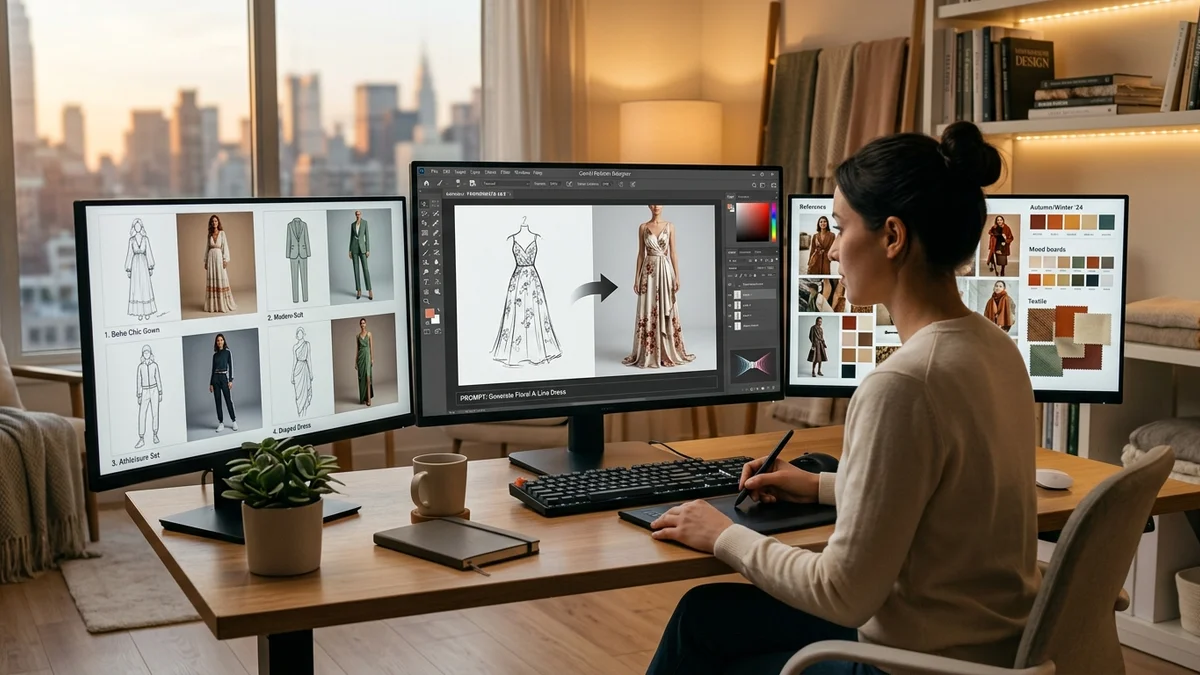
AI generated clothing refers to fashion designs created using artificial intelligence algorithms. You provide a text description, sketch, or reference image, and the AI produces a visual representation of the garment. The output can range from rough concept art to photorealistic product images ready for e-commerce catalogs.
These tools use generative AI models trained on millions of fashion images. The AI understands fabric textures, color combinations, garment structures, and how clothes drape on different body types. Some platforms specialize in 2D design images while others produce 3D renders with realistic fabric simulation.
There are three main categories of AI generated clothing tools:
| Category | What It Does | Best For |
|---|---|---|
| Text-to-design generators | Creates clothing images from written descriptions | Quick concept exploration |
| Sketch-to-garment tools | Converts rough sketches into polished designs | Designers with existing ideas |
| AI fashion model generators | Places clothing on virtual models | E-commerce product photos |
73% of fashion executives now list AI-driven design tools as a top-three priority for digital investment.
Key Takeaway: AI generated clothing bridges the gap between imagination and visual reality, letting anyone turn fashion ideas into professional-looking designs without traditional design skills.
How Does an AI Clothing Generator Work?
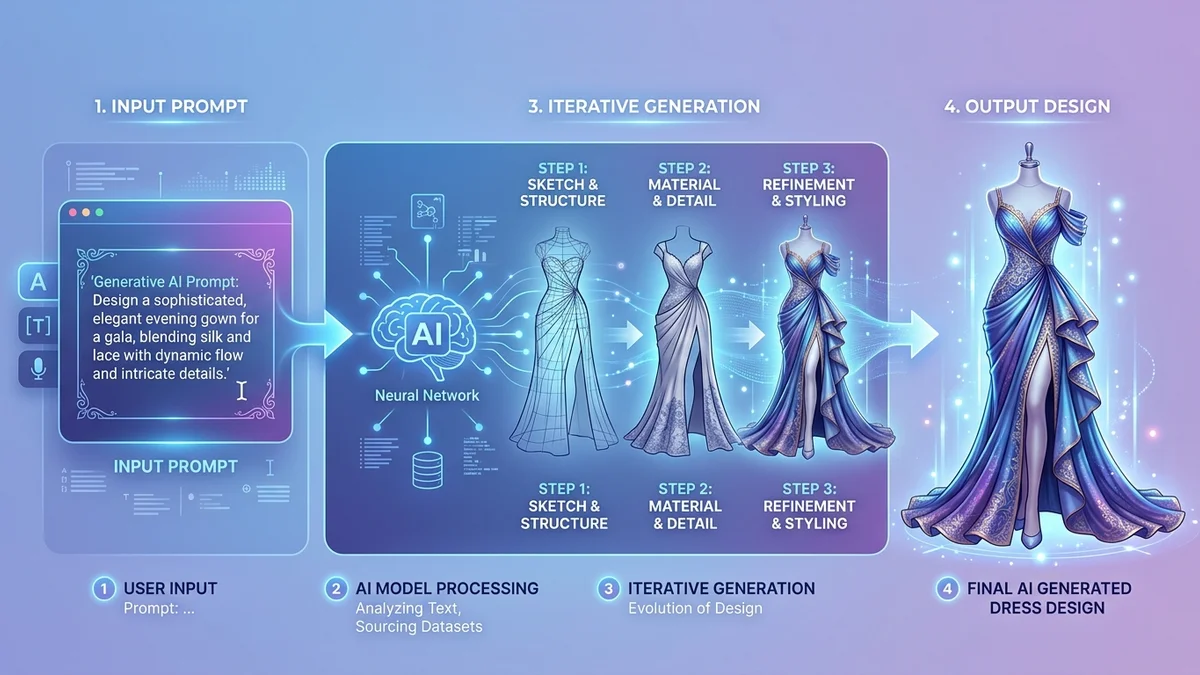
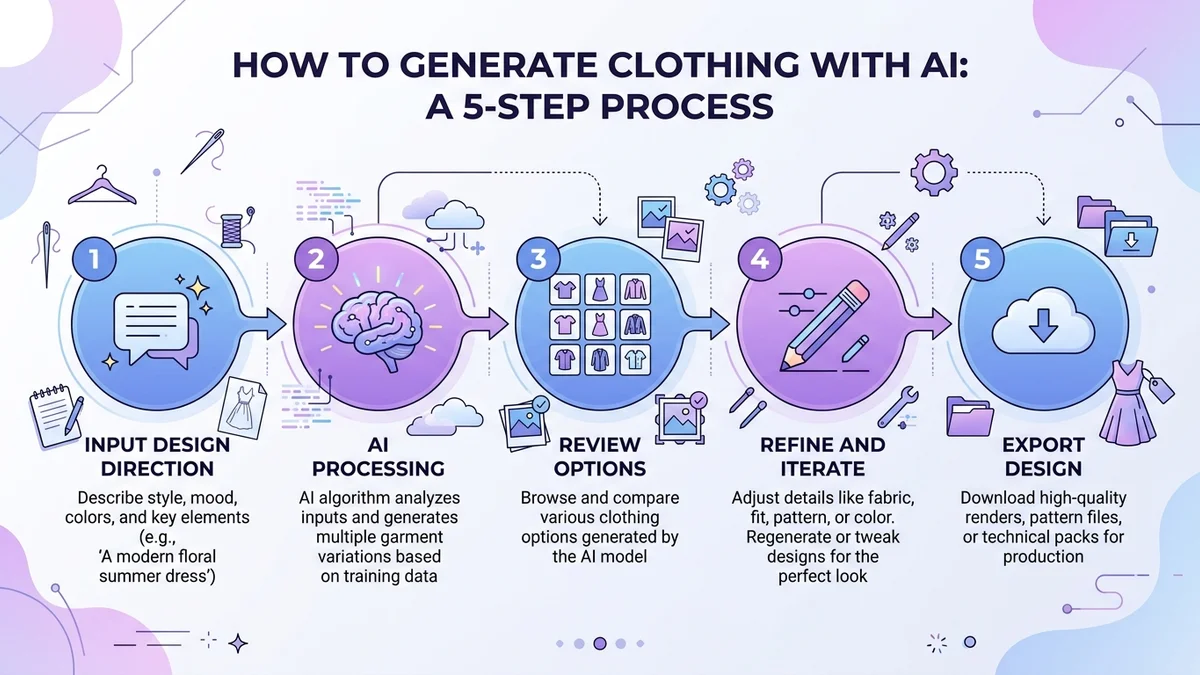
An AI clothing generator works by processing your input through a trained neural network that understands fashion concepts. You describe what you want, the AI interprets your request, and it generates one or more visual options. The entire process takes between 10 and 30 seconds on most platforms.
Here is how the typical workflow breaks down:
- Input your design direction - Type a text prompt describing the garment (style, color, fabric, details) or upload a sketch
- AI processes your request - The generative model analyzes your input against its training data of fashion images
- Review generated options - Most tools produce 2-4 variations for you to compare
- Refine and iterate - Adjust your prompt or use editing tools to tweak specific elements
- Export your design - Download the final image in high resolution for your needs
The underlying technology combines several AI approaches. Diffusion models like Stable Diffusion form the backbone of many generators. GANs (Generative Adversarial Networks) help produce realistic textures and patterns. Some platforms add fashion-specific training data to improve accuracy for clothing-related outputs.
Prompt quality matters a lot. A vague prompt like "nice dress" gives generic results. A specific prompt like "midi-length A-line dress in sage green linen with puff sleeves and a square neckline" produces much better output. The more detail you provide about fabric, cut, color, and style, the closer the result matches your vision.
| Prompt Quality | Example | Result Quality |
|---|---|---|
| Vague | "cool shirt" | Generic, unpredictable |
| Basic | "blue button-down shirt" | Decent but standard |
| Detailed | "oversized navy cotton Oxford shirt with white pearl buttons and a relaxed fit" | Accurate, specific |
| Expert | "cropped sage green linen blazer with notch lapels, single-button closure, and raw hem details, editorial flat lay on marble surface" | Professional, publication-ready |
Key Takeaway: Better prompts produce better AI generated clothing. Spend time describing fabric, color, silhouette, and styling details for the best results.
What Are the Best AI Clothing Generator Tools in 2026?
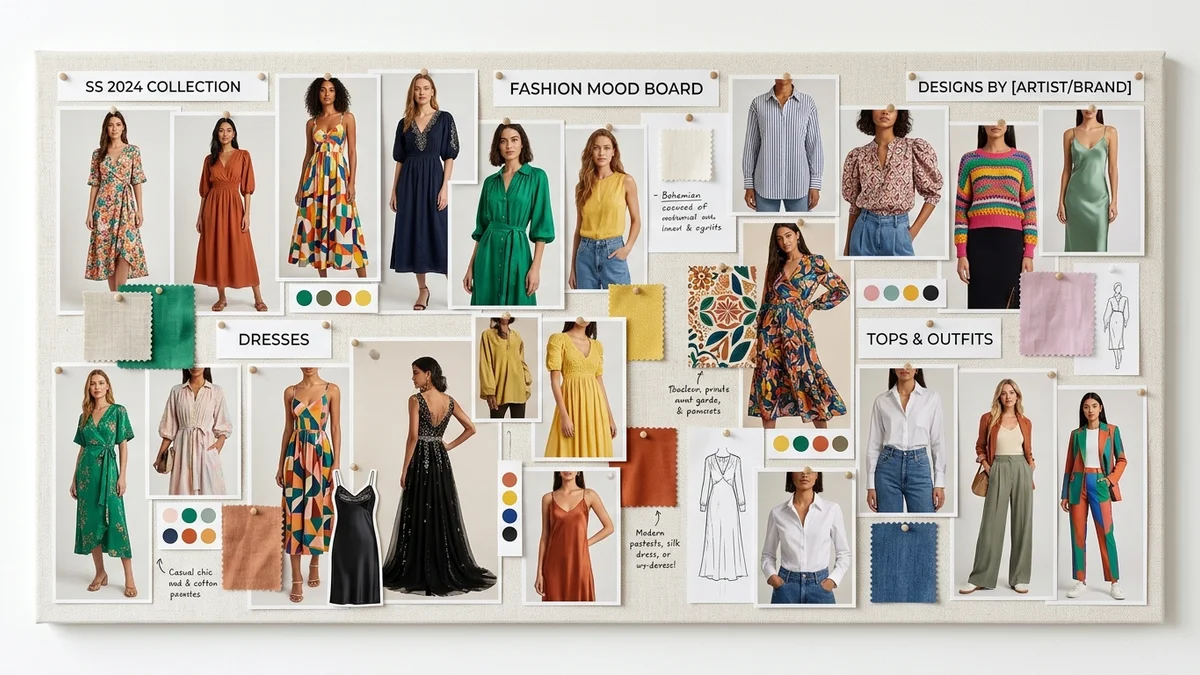
The best AI clothing generators in 2026 combine speed, quality, and ease of use. Some focus on design exploration while others specialize in producing e-commerce-ready product images. Here are the top options ranked by overall value.
The New Black
The New Black is one of the most popular AI fashion design platforms. It offers text-to-design generation, AI fashion models, and collection planning tools. You can generate AI clothing designs for shirts, dresses, accessories, and full outfits. Pricing starts with a free trial, then subscription plans begin at around $30 per month.
Style3D AI
Style3D AI stands out for its 3D garment simulation. It converts sketches into realistic clothing renders with accurate fabric draping in under 30 seconds. The platform works well for designers who need to see how garments will look in three dimensions before production. A free tier is available with limited renders.
Fotor AI Clothing Generator
Fotor provides a straightforward text-to-clothing tool with free credits for new users. It works well for quick concept generation and social media content. The interface is simple enough for beginners while still producing quality results.
Resleeve AI
Resleeve focuses specifically on fashion design workflows. It handles sketch-to-design conversion, pattern generation, and collection management. Fashion brands use it to speed up their design process by testing hundreds of variations before selecting final concepts.
OpenArt
OpenArt offers unlimited free generations on basic models, with premium features available through credits. It handles general-purpose image generation well and works for clothing designs when you use fashion-specific prompts.
| Tool | Free Tier | Best Feature | Speed | Best For |
|---|---|---|---|---|
| The New Black | Trial | AI fashion models | Fast | Full fashion workflow |
| Style3D AI | Limited | 3D fabric simulation | Very fast | Technical designers |
| Fotor | Credits | Simplicity | Fast | Beginners |
| Resleeve | Trial | Sketch conversion | Medium | Fashion brands |
| OpenArt | Unlimited basic | Model variety | Fast | General exploration |
For virtual try-on technology that lets you see these AI designs on your own body, tools like CheckMyFit take it a step further by showing how generated clothing would actually look on you.
Can You Create AI Generated Dresses and Shirts?
Yes, you can create any type of garment with AI clothing generators. AI generated dresses and AI generated shirts are among the most common outputs because these garments have clear visual structures that AI models handle well.
For AI generated dresses, specify these details in your prompt:
- Dress length (mini, midi, maxi, floor-length)
- Silhouette (A-line, bodycon, shift, empire waist, mermaid)
- Neckline (V-neck, square, halter, off-shoulder, sweetheart)
- Sleeve style (sleeveless, cap, puff, long, bell)
- Fabric (silk, cotton, chiffon, velvet, linen)
- Color and pattern (solid, floral, geometric, abstract)
For AI generated shirts, include:
- Shirt type (button-down, polo, t-shirt, blouse, henley)
- Collar style (spread, button-down, mandarin, band)
- Fit (slim, regular, oversized, cropped)
- Fabric weight (lightweight, medium, heavy)
- Design elements (pockets, prints, embroidery)
The AI fashion photography market grew to $2.01 billion in 2025, driven largely by AI generated product images for shirts and dresses.
You can also generate more complex pieces like tailored suits, outerwear, activewear, and accessories. The key is writing detailed prompts that describe exactly what you want. Most generators handle casual and commercial fashion better than highly technical or avant-garde designs.
Key Takeaway: AI handles dresses and shirts particularly well. Use specific prompts covering silhouette, fabric, color, and details for the most accurate results.
How Do Fashion Brands Use AI Generated Clothing?
Fashion brands use AI generated clothing across their entire workflow, from initial concept to marketing campaigns. The adoption rate has accelerated in 2026, with over 70% of fashion executives prioritizing AI design tools.
Design and prototyping is the top use case. Designers generate hundreds of concepts digitally before selecting the best ones for physical samples. This cuts the design phase from weeks to days. One fashion designer reported going from "two weeks of studio time to overnight generation for an entire season."
E-commerce product photography is the second biggest application. Brands use AI to generate fashion model images wearing their clothing, eliminating the need for expensive photo shoots. Global e-commerce content producers now create AI-generated product imagery for over 900 brands worldwide, supporting the production of 14 million pictures and videos per year.
Marketing and social media content benefits too. Brands generate campaign visuals and ad creative faster than traditional production cycles allow. Valentino shared AI-generated campaign imagery in late 2025, signaling mainstream luxury adoption.
| Use Case | Time Saved | Cost Reduction | Adoption Rate |
|---|---|---|---|
| Design prototyping | 70-80% | 40-60% | High |
| Product photography | 50-60% | Up to 90% | Growing fast |
| Marketing campaigns | 40-50% | 30-50% | Moderate |
| Trend forecasting | 60-70% | 20-30% | Early stage |
Key Takeaway: Brands save time and money by using AI to prototype designs, generate product photos, and create marketing content without traditional production costs.
AI Generated Clothing vs Traditional Fashion Design
AI clothing generators are not replacing traditional fashion design. Instead, they work best as a complement to existing creative processes. Understanding the strengths and limitations of each approach helps you choose the right method for your needs.
Where AI excels:
- Rapid concept generation (hundreds of ideas in minutes)
- Visual exploration of color and pattern combinations
- Creating product mockups without physical samples
- Generating clothing images for e-commerce
- Testing designs with different body types and skin tones
Where traditional design still leads:
- Technical pattern making and garment construction
- Working with physical fabrics and understanding drape
- Couture and highly detailed handwork
- Understanding fit and wearability from a tactile perspective
- Building a cohesive collection with a strong narrative
The most effective approach combines both. Start with AI to explore broad concepts quickly, then refine your top choices using traditional design methods. This hybrid workflow reduces wasted time on ideas that don't work while keeping the human creativity that makes fashion special.
How to Get Better Results from AI Clothing Generators
Getting quality output from AI clothing generators requires practice with prompting and understanding each tool's strengths. Here are proven tips that improve your results immediately.
Be specific with fabric descriptions. Instead of "soft fabric," say "brushed cotton twill" or "lightweight silk crepe de chine." AI models trained on fashion data understand specific textile terms and produce more realistic textures when you use them.
Reference real fashion terminology. Use terms like "princess seams," "dart placement," "bias cut," or "French cuffs." The AI recognizes industry-standard vocabulary and translates it into accurate visual details.
Specify the image context. Tell the AI whether you want a flat lay on a white background, a garment on a model walking down a street, or a close-up detail shot. Context dramatically affects the output quality and usefulness.
Use negative prompts when available. Many generators let you specify what you do not want. Adding negative prompts like "no wrinkles, no extra fingers, no distorted proportions" helps avoid common AI artifacts.
Iterate in rounds. Start with a broad concept, identify what works, then refine your prompt to focus on the best elements. Three rounds of iteration typically produce much better results than one attempt.
For seeing how AI-designed outfits look on your body, virtual try-on platforms like CheckMyFit let you upload your photo and visualize any clothing design on yourself before making decisions.
Recommended Products for AI Fashion Design

Take stable reference photos of your clothing for AI input. Works with any smartphone and includes a Bluetooth remote for hands-free shooting.
View on Amazon →
Professional lighting for capturing garment photos that AI tools process better. Even lighting eliminates shadows and helps AI generators produce more accurate results.
View on Amazon →
Build your fashion vocabulary and style knowledge to write better AI prompts. Understanding silhouettes, proportions, and color theory directly improves AI generated clothing results.
View on Amazon →Frequently Asked Questions
Is AI generated clothing free to create?
Many AI clothing generators offer free tiers or trial credits. OpenArt provides unlimited free generations on basic models. Fotor and Style3D AI give new users free credits to test their features. Paid plans typically start at $10 to $30 per month and offer higher quality outputs, more generations, and advanced features like batch processing and API access.
Can AI generate realistic clothing images for e-commerce?
Yes, modern AI tools produce photorealistic clothing images suitable for online stores. Platforms like Uwear, Botika, and Claid.ai specialize in generating product photos with AI models wearing your garments. The quality is good enough that over 900 global brands now use AI-generated product imagery in their catalogs.
What types of clothing can AI generate?
AI can generate nearly any garment type including dresses, shirts, pants, outerwear, activewear, swimwear, and accessories. Casual and commercial fashion produces the best results. Highly detailed couture pieces or technically complex garments like tailored suits may need more prompt refinement to get accurate outputs.
Do I own the designs AI generates?
Ownership depends on the platform you use. Most commercial AI clothing generators grant you full rights to use generated images for personal and commercial purposes. Always check the specific terms of service for your chosen tool. Some platforms require attribution while others allow unrestricted use with paid plans.
How accurate are AI generated clothing designs?
Accuracy varies by tool and prompt quality. Top platforms achieve results that closely match your description for common garment types. Complex details like intricate lacework, specific construction techniques, or unusual fabric textures may not render perfectly. Using detailed, fashion-specific prompts significantly improves accuracy.
Can AI replace fashion designers?
AI tools are best used as design assistants, not replacements. They speed up the concept phase and help explore more ideas faster. However, human creativity, understanding of cultural context, technical construction knowledge, and the ability to work with physical materials remain uniquely human skills that AI cannot replicate.
How do I create AI generated shirts with custom graphics?
Start with a prompt that describes the shirt style and graphic separately. For example: "white cotton crew-neck t-shirt with a minimalist black line drawing of a mountain range across the chest." Most generators handle graphic placement on shirts well. For more control, generate the graphic separately and use an image editing tool to place it on a blank shirt template.
What resolution do AI clothing generators produce?
Most tools generate images between 512x512 and 2048x2048 pixels. Free tiers often limit resolution to 1024x1024. Higher resolutions suitable for print production typically require paid plans. Some platforms offer upscaling features that enhance lower-resolution outputs to print-ready quality.
Conclusion
AI generated clothing has moved from experimental technology to an everyday tool for designers, brands, and creative hobbyists. The best generators in 2026 produce results that are fast, affordable, and good enough for real commercial use.
Start by picking one free tool and experimenting with detailed prompts. Focus on specific garment details like fabric, silhouette, and color to get the most useful outputs. As you get comfortable, explore multiple platforms to find which one matches your workflow best.
Want to see how any clothing design would look on your actual body? Try CheckMyFit to upload your photo and visualize outfits with virtual try-on technology. It is the fastest way to go from AI-generated concept to a real preview of how clothes fit you.